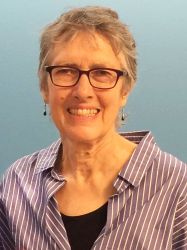
Dr. Peg Barratt is currently a professor of Applied Social Psychology at George Washington University (GW) in Washington, DC, USA. Dr. Barratt includes solar cooking in her courses and strongly believes that the social psychology of behavior change is critical in spreading the use of solar cookers. She is an avid traveler and has promoted the use of solar cookers in Cameroon, Japan and the Gambia. Peg made her first solar cooker with her son in 2006 and helped with his solar cooking science project. She attended the 2014 Solar Cookers International World Conference in Sacramento and has collaborated on solar cooking projects with long-time SCI volunteer Afzal Syed who she met at that conference. Dr. Barratt also demonstrated solar cooking and drying on Cable TV’s “Emerald Planet.”
Dr. Barratt served as a faculty member teaching psychology courses with the Institute for Shipboard Education and the University of Virginia’s program Semester at Sea. This drew upon her considerable international travel, cross-cultural research, and three long term stays in Japan, beginning in 1988. Dr. Barratt was also a Visiting Researcher and United States Fulbright Scholar to the Graduate School of Asian and African Area Studies at Kyoto University in Japan. As a developmental psychologist specializing in the area of parent-child interaction with a focus on naturalistic field work, she studied the decisions mothers make for their infants.
Dr. Barratt was the Dean of the Columbian College of Arts and Sciences at GW and she has a broad administrative background in both the higher education and government sectors. She served in leadership positions at the National Institutes of Health, National Science Foundation, and Michigan State University, where she was the director of the Institute for Children, Youth and Families. For nineteen years, she was a faculty member at the University of Wisconsin–Madison and served as department chair. During her tenure at Wisconsin–Madison, she was honored with a Distinguished Teaching Award.
Dr. Barratt is an alumna of GW’s graduate program in psychology and holds a doctorate in developmental psychology from the University of Wisconsin–Madison. She also earned master’s and bachelor’s degrees in psychology from Michigan State University. Dr. Barratt is a fellow of the American Psychological Association and the Association for Psychological Science; and her research has been published extensively in various scholarly journals.
“I am compelled to join the SCI board because solar cooking is a simple and sustainable solution to many issues that are dear to my heart. As a researcher and advocate for women and their families, solar cooking appeals to me since it increases their safety and protects their health. Solar cooking provides an opportunity for women to become economically self-sufficient and girls to attend school. Plus, solar cooking is good for the environment.”
When not teaching, Dr. Barratt travels, hikes, kayaks, runs, makes jewelry and welds.
Dr. Barrett joined the SCI Board of Directors in early 2019.